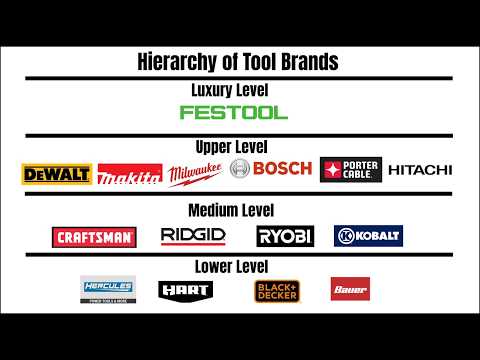
From a lifetime of buying and collecting tools, I’ll share the things I’ve learned about buying power tools, some mistakes I’ve made and the best advice I can give for how to build your own tooling arsenal. There are some things that I’ve learned from being a consumer and some things I’ve learned from being a manufacturing engineer that will illuminate how some products can be terrible when the rest of company’s catalogue is pretty fantastic. Bob next door may swear by this orbital sander but when you got the exact same version, it didn’t live up to the hype. There are reasons for this and the answers may surprise you.
Intro – 0:00
What is the Application? – 1:07
What is Your Skill Level? – 1:53
Brush or Brushless? – 2:35
What Features Do I Need? – 3:30
What is Your Future Vision? – 3:58
More Tools for Less? – 5:10
Buy the Warranty – 5:48
Two for the Price of One? – 6:20
How Long are You Keeping Your Tools? – 6:42
Hierarchy of Tooling Brands – 7:30
Cheaper Versions of the Same Tool? – 8:52
Battery Eco System – 9:30
THE TRUTH – 11:35
Brand Quality Fluctuation – 12:23
Unreliable Reviews – 14:45
Avoid this Brand – 15:06
Be the Expert – 15:19
Big Box Stores vs Local Professional Stores – 15:48
Asking the Pros and Summing It Up – 17:14
you need another category for Hilti
I’ll possibly get shouted down for this, but I work on an iron ore mine in the remote desert in Western Australia. We predominantly use Milwaukee. I’m not a big fan. I had Panasonic tools but they basically lost interest in cordless tools and while they were very nice, they became a dead end long ago. I was torn which brand to buy for my home workshop.
I settled on Makita. Not the sexiest or coolest brand but after using Milwaukee and Makita in some of the harshest environments possible, I noticed a few things.
Milwaukee are quick to innovate some exciting new tools and solutions. Makita definitely aren’t in any rush to release products or go out of their way to satisfy customers wishes.
However, Makita clearly place more importance on durability and their R&D is more exhaustive. A good example is Milwaukee 3/4” rattle guns fail one after another. The battery wobbles around and arc erodes the battery contacts until they are un usable. Granted, they are very proactive in replacing with new. I like their compact 12v range but again, in harsh environments, the battery releases mechanism either sticks or fall off. IK find Makita specs are generally lower but in use, 800Nm verses 950Nm is often academic.
I think the TTI group is more nimble and aggressive with product releases and overall having a more can do attitude.
I sometimes worry that Makita is shackled by the rigid Japanese corporate culture. In Japan, a young brilliant talent rarely gets fast tracked to the top of a company. Very often, the decision makers at their companies are quite elderly men who had to wait their 40-50yrs to get to that position. I hope Japan can become more flexible and adapt. I don’t want the Japanese pride in workmanship to one day become unavailable.
Once again, great vid!
between this and the cad software comparison you got yourself a new subscriber
You will have lots of subs one day, very nice
I have 3 Festools for very specific purposes. The rotex 90 sander with the 3 1/2 disc is perfect for sanding slats on my glider , deck spindles, etc and small woodworking projects. The 1010 router is awesome for woodworking. The ct15 vacuum packs a wallop. Most corded stuff is makita. I use 12v Bosch and 18v Milwaukee